

Bitcoin Price: Live Value, Chart and Key Market Drivers


Introduction
Bitcoin (BTC) price represents the current market value of the world's first decentralized cryptocurrency. Readers who want to learn more about Bitcoin's fundamentals, history, and how it works can explore our guide What Is Bitcoin? As the largest cryptocurrency by market capitalization, Bitcoin is traded globally 24/7, and its price changes continuously based on market supply, demand, and broader market conditions.
Unlike traditional assets that are influenced by centralized financial systems, Bitcoin operates on a decentralized network with a fixed maximum supply of 21 million BTC. These unique characteristics, combined with market activity, investor sentiment, and macroeconomic factors, contribute to Bitcoin's price movements.
This guide explains Bitcoin price trends, the key factors that influence BTC value, how to read Bitcoin price charts, and the risks associated with cryptocurrency price volatility.
Current Bitcoin Price Snapshot
Bitcoin price changes constantly based on market supply and demand, trading activity, and overall market conditions. The current Bitcoin price is usually displayed in USD and other major currencies through cryptocurrency exchanges and market data platforms.
Bitcoin price data updated on July 30, 2026.
When checking the Bitcoin price today, readers typically look at key market data such as:
Metric | Description | Data |
Bitcoin Price (BTC/USD) | The current market value of one Bitcoin measured in US dollars | $63,908 |
Market Capitalization | The total value of all Bitcoin currently in circulation | $1,350 Billion |
24h Trading Volume | The amount of Bitcoin traded within the last 24 hours | $26.8 Billion |
Price Change | Recent BTC price movement over different time periods | 1.28% |
Readers can check the latest Bitcoin price, BTC/USD market data, and real-time price changes through the Bitcoin Today Price page.
Bitcoin is traded globally 24/7 across cryptocurrency markets, meaning its price can fluctuate continuously. Users should consider both short-term price movements and broader market trends when analyzing BTC price changes.
How Bitcoin Price Is Calculated
Bitcoin price is determined by market supply and demand across cryptocurrency markets. Unlike traditional currencies that are influenced by central banks or monetary policies, Bitcoin's price is mainly formed through trading activity between buyers and sellers.
The BTC price shown on exchanges usually reflects the latest market transactions. When buying demand increases compared with selling pressure, Bitcoin price may rise. Conversely, stronger selling activity may put downward pressure on BTC price.
Several factors influence Bitcoin price formation, including:
Factor | Description |
Market Supply and Demand | The balance between buyers and sellers directly affects BTC price movements |
Trading Activity | Higher trading volume and market participation can influence short-term price changes |
Market Liquidity | Liquidity conditions affect how easily Bitcoin can be bought or sold at current prices |
Market Sentiment | Investor expectations and confidence can impact buying and selling behavior |
Bitcoin price is continuously updated because cryptocurrency markets operate 24/7. Different exchanges may show slightly different BTC prices due to differences in liquidity, trading volume, and market participants.
Bitcoin Price Historical Context
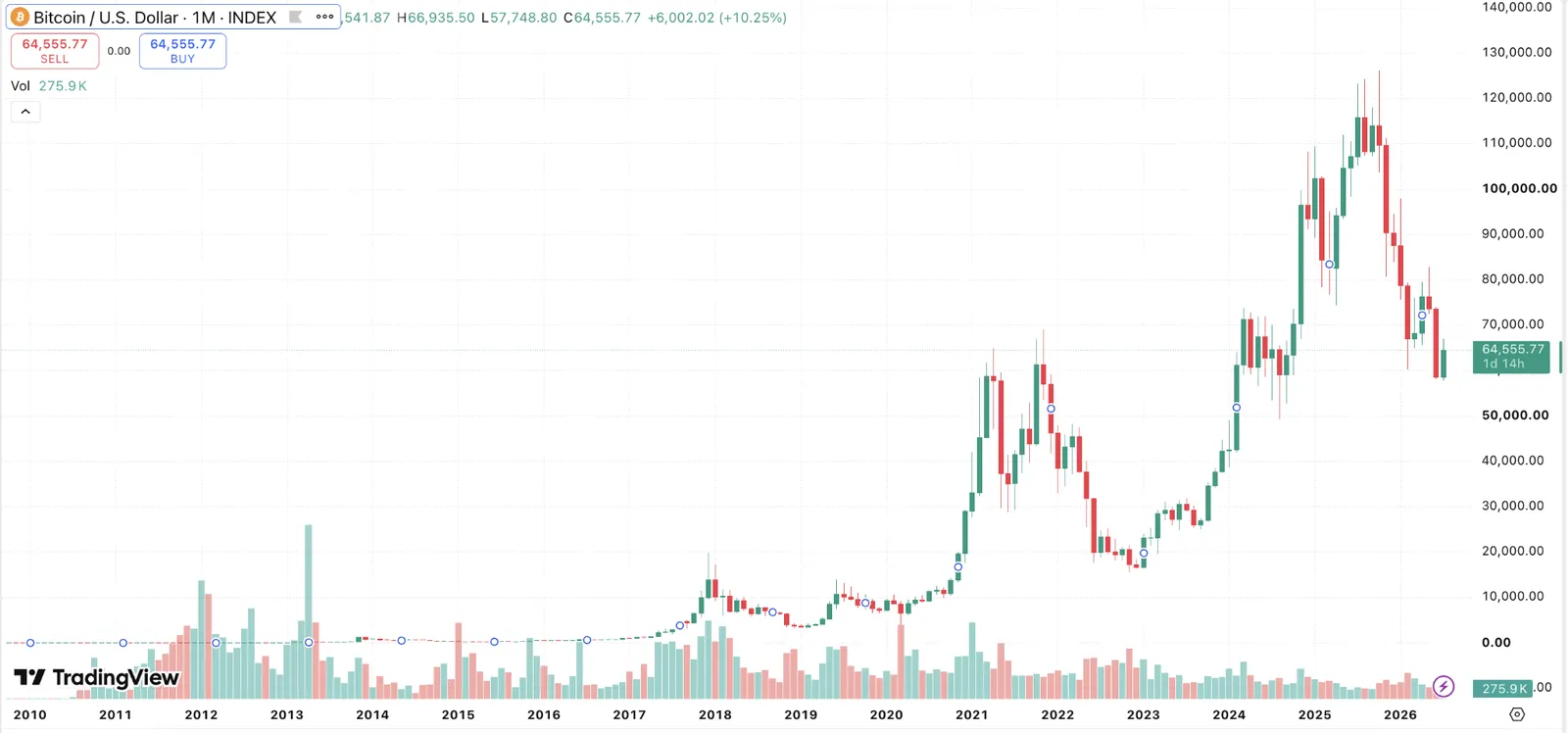
Historical Bitcoin price chart showing BTC price movements from 2009 to July 30, 2026 (monthly candlestick chart)
Bitcoin has experienced significant price changes since its launch in 2009. From an experimental digital currency used by a small community, Bitcoin has developed into a globally recognized digital asset with participation from individual investors, institutions, and financial markets.
Bitcoin's historical price movement can be understood through several major development stages:
Early Development and Adoption (2009–2016)
In Bitcoin's early years, the cryptocurrency market was relatively small, and Bitcoin was mainly used by developers, technology enthusiasts, and early adopters.
During this period, Bitcoin gradually established its network infrastructure, gained exchange support, and demonstrated the potential of decentralized digital assets.
First Major Market Cycle (2017–2018)
Bitcoin attracted significant public attention during the 2017 cryptocurrency market cycle.
Growing retail interest, increased media coverage, and expansion of cryptocurrency exchanges contributed to increased market activity. After reaching a major market peak, Bitcoin experienced a substantial correction as the market entered a downturn.
This period highlighted Bitcoin's high volatility and the cyclical nature of cryptocurrency markets.
Institutional Adoption and Market Maturity (2020–2022)
Bitcoin gained broader recognition as more institutions, companies, and investors began exploring digital assets.
Factors such as increased institutional participation, changing macroeconomic conditions, and growing cryptocurrency adoption influenced Bitcoin's price movements during this period.
Bitcoin's role also expanded from an experimental payment system to a widely discussed digital asset and potential store of value.
Recent Market Development (2023–Present)
In recent years, Bitcoin has continued to develop alongside the broader digital asset industry.
Increasing institutional involvement, evolving regulations, and changes in global financial conditions have become important factors affecting BTC price trends. Bitcoin's market behavior is now influenced by both cryptocurrency-specific factors and broader financial market conditions.
Understanding Bitcoin's historical price context helps explain how adoption, market cycles, and external factors have influenced BTC value over time. While past performance does not predict future results, historical cycles provide useful insights into how adoption, market sentiment, and external factors can influence Bitcoin's value.
Key Factors That Influence Bitcoin Price
Bitcoin price is influenced by multiple factors, including market demand, investor sentiment, macroeconomic conditions, and developments within the cryptocurrency industry.
Unlike traditional financial assets that may rely on company earnings or government policies, Bitcoin's value is mainly driven by market participation, adoption, and expectations about its future role in the global financial system.
Supply Dynamics
Bitcoin's fixed maximum supply of 21 million BTC is an important factor influencing its long-term market structure. Bitcoin halving events also affect the rate of new BTC issuance, which can influence market expectations around supply.
Market Sentiment and Investor Behavior
Bitcoin price is highly influenced by market sentiment and investor expectations.
Positive news, increased adoption, institutional interest, or favorable market conditions may increase demand for BTC. On the other hand, market uncertainty, negative sentiment, or fear-driven selling can contribute to price declines.
Because cryptocurrency markets operate continuously, changes in sentiment can quickly affect Bitcoin price movements.
Institutional Adoption and Market Participation
Growing participation from institutions, companies, and financial products has become an important factor affecting Bitcoin's market development.
Institutional investment, Bitcoin-related financial products, and broader acceptance of digital assets can influence market demand and investor confidence.
Macroeconomic Conditions
Bitcoin price can also be affected by broader economic conditions.
Factors such as interest rates, inflation expectations, currency conditions, and global financial market trends may influence how investors allocate capital between traditional assets and digital assets.
During periods of economic uncertainty, some investors may consider Bitcoin as an alternative asset, while changing market conditions can also reduce demand.
Regulation and Industry Developments
Regulatory changes and developments within the cryptocurrency industry can significantly impact Bitcoin price.
Government policies, taxation rules, exchange regulations, and legal frameworks may affect market participation and investor confidence.
Similarly, developments such as improvements in cryptocurrency infrastructure, institutional services, and blockchain adoption can influence Bitcoin's long-term market outlook.
Bitcoin Network Events
Bitcoin-specific events, such as protocol upgrades and major network developments, can also influence market expectations.
Among these events, Bitcoin halving is one of the most widely discussed factors because it changes the rate of new BTC issuance.
How to Read a Bitcoin Price Chart
A Bitcoin price chart shows how the value of BTC changes over time. By understanding key elements of a price chart, users can better interpret historical price movements, market trends, and trading activity.
Bitcoin price charts are commonly available on cryptocurrency exchanges and market data platforms. They usually include information such as price movement, trading volume, market capitalization, and different time periods.
Bitcoin Price and Time Periods
The most basic element of a Bitcoin price chart is the relationship between BTC price and time.
Users can view Bitcoin price movements across different time ranges, such as:
Time Period | What It Shows |
Short-term | Recent price movements and market activity |
Medium-term | Trends over weeks or months |
Long-term | Historical cycles and broader market development |
Choosing different time periods can provide different perspectives on Bitcoin's market performance.
Candlestick Charts
Many Bitcoin price charts use candlesticks to display price movements within a specific time period.
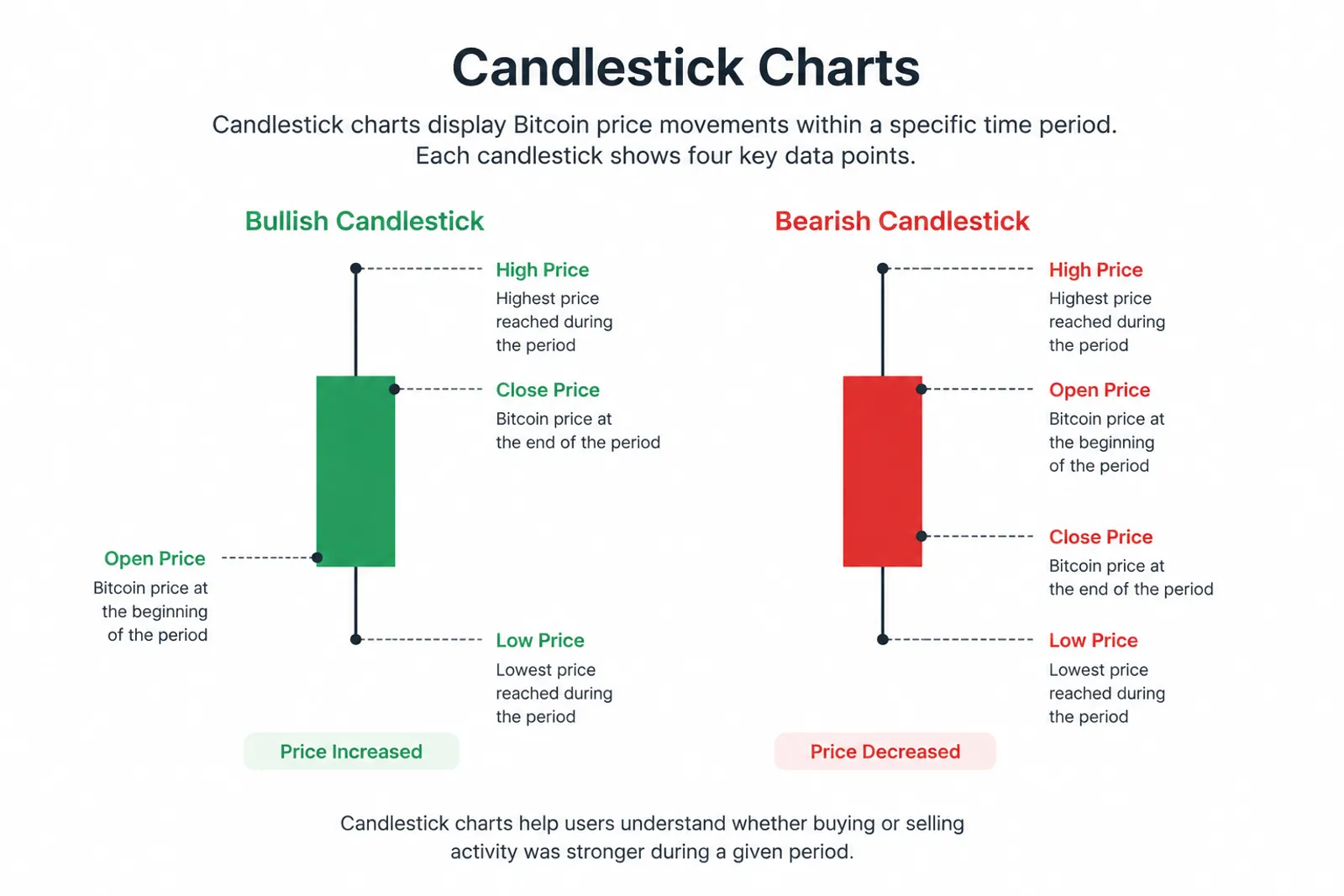
Bitcoin candlestick chart explaining BTC price movements and key data points
Each candlestick typically shows four key data points:
Data Point | Meaning |
Open Price | Bitcoin price at the beginning of the period |
Close Price | Bitcoin price at the end of the period |
High Price | Highest price reached during the period |
Low Price | Lowest price reached during the period |
Candlestick charts help users understand whether buying or selling activity was stronger during a given period.
Trading Volume
Trading volume shows how much Bitcoin has been traded within a specific period.
Higher trading volume often indicates stronger market activity, while lower volume may suggest reduced participation. Volume is commonly viewed together with price changes to understand market momentum.
Market Capitalization
Market capitalization is one of the most commonly used metrics to evaluate the size and market position of Bitcoin.
Bitcoin's market capitalization is generally calculated using the following formula:
Market Capitalization = Current Bitcoin Price × Circulating Supply
The circulating supply refers to the amount of BTC currently available in the market. Bitcoin's circulating supply increases over time through the mining process until reaching the maximum supply limit.
For example, if Bitcoin is trading at $100,000 and the circulating supply is 19.8 million BTC, the approximate market capitalization would be:
$100,000 × 19.8 million BTC = $1.98 trillion
However, some platforms also display Fully Diluted Market Cap (FDMC), which uses Bitcoin's maximum supply instead of the current circulating supply:
Fully Diluted Market Capitalization = Current Bitcoin Price × Maximum Supply (21 million BTC)
This metric estimates Bitcoin's theoretical valuation if all BTC were already in circulation.
For most market analysis, circulating market capitalization is the more commonly used indicator because it reflects the actual amount of Bitcoin currently available in the market.
Risks of Bitcoin Price Volatility
Bitcoin is known for its significant price fluctuations compared with many traditional financial assets. The BTC price can change rapidly within short periods due to market demand, investor sentiment, economic conditions, and broader cryptocurrency market trends.
Several factors contribute to Bitcoin's price volatility:
Market Liquidity
Compared with traditional financial markets, the cryptocurrency market is still developing. Changes in trading activity and liquidity conditions can have a greater impact on Bitcoin price movements.
External Economic Factors
Macroeconomic factors such as interest rates, inflation expectations, and global financial conditions can influence how investors view Bitcoin and other digital assets.
Regulatory Developments
Changes in cryptocurrency regulations and government policies can affect market confidence and influence Bitcoin price movements across different regions.
Understanding Bitcoin price volatility is important for anyone tracking BTC markets. While Bitcoin's historical performance has attracted significant attention, past price movements do not guarantee future results, and users should consider market risks before making investment decisions.
FAQs
What Is the Current Bitcoin Price?
The price of Bitcoin changes constantly based on market supply, demand, trading activity, and overall market conditions. For real-time Bitcoin price information, readers can visit the CoinEx Bitcoin Price page.
Why Does Bitcoin Price Change So Much?
Bitcoin price is affected by factors such as market sentiment, trading volume, liquidity, economic conditions, and regulatory developments. As the cryptocurrency market is still developing, BTC can experience significant price movements.
Why Is Bitcoin Price Different on Different Platforms?
Bitcoin prices may vary slightly across exchanges because each platform has different trading activity, liquidity, and market participants.
What Determines Bitcoin's Market Cap?
Bitcoin's market capitalization is calculated by multiplying the current BTC price by the circulating supply:
Market Capitalization = Current Bitcoin Price × Circulating Supply
What Was Bitcoin's Highest Price?
As of July 2026, Bitcoin's highest recorded price was approximately $126,198 per BTC, reached on October 6, 2025.
Bitcoin has reached new all-time highs during different market cycles, driven by factors such as increasing adoption, institutional participation, market demand, and broader financial conditions. While Bitcoin may reach new highs in the future, its price depends on various factors, including market conditions, investor sentiment, regulation, and cryptocurrency adoption.
Where Can I Buy Bitcoin?
Readers who want to purchase Bitcoin can learn more about different buying methods through our guide How to Buy Bitcoin.
Disclaimer
Disclaimer: This article is for informational purposes only and does not constitute financial advice. Bitcoin prices can be highly volatile and may change significantly due to market conditions, liquidity, regulation, and other factors. Readers should conduct their own research and consider their risk tolerance before making decisions related to digital assets.